


Getting a divorce can be an incredibly stressful and exhausting process, particularly if your soon-to-be ex-partner is stubborn. Regardless of whether your partner is co-operative, the added stress of dealing with finances and the children alone can be a lot to handle.
But part of the battle is understanding what lies ahead and, in recent years, divorce has been simplified to make it more accessible for everyone. The introduction of ‘no-fault’ divorces and the ability to apply for divorce online cut out much of the anxiety and bureaucracy that used to plague anyone getting a divorce.
Most married couples will either have a home or children together, or both, and while the process to legally end a marriage is simple, agreeing on how to divide assets, finances and childcare can be challenging. This is where you may need a divorce solicitor to advise you.
As a Family Solicitor at Britton and Time Solicitors, I’ve compiled this guide to outline the entire divorce process spanning everything from your options pre-divorce, to what to do once your Final Order has come through and you’re officially single again. It covers everything you’ll need to prepare, what you should consider, and how to go through the whole process from start to finish.
Below, you’ll find some basic information on getting a divorce in England and Wales, but other articles that expand on these areas in more detail will be featured throughout.
Getting a divorce: preparations
Before you take the plunge and start getting a divorce, it’s important to consider what this choice entails. Divorce is final and there may be elements you haven’t considered, alongside other options that may suit your situation better.
What do I need to consider?
Before you start your divorce application, it’s worth first considering a number of things that may affect the process:
- Money – whilst fees for the divorce alone are minimal, it can become costly when financial proceedings sour. Think about what situation you or your spouse will be in if you cannot reach a mutual agreement, as court fees can add up quickly.
- Living standards – once a marriage has broken down, it’s common for one partner to move out during proceedings to give the other space. If you have the luxury of doing so, decide early on where each of you will be living to help you both finalise your divorce faster.
- Who else does it affect – If you have children, other family members living with you, or even pets, think about how the divorce may affect them. It’s best, if possible, to keep divorce discussions private until you settle on a route forward. Those around you will be impacted and most likely have opinions, which may or may not be helpful.
- Do you truly want it? – Divorce is a big choice to make and many couples make it back from the brink of getting divorced. If you’re having doubts, you should consider looking at alternatives before taking a step that may be irreversible.
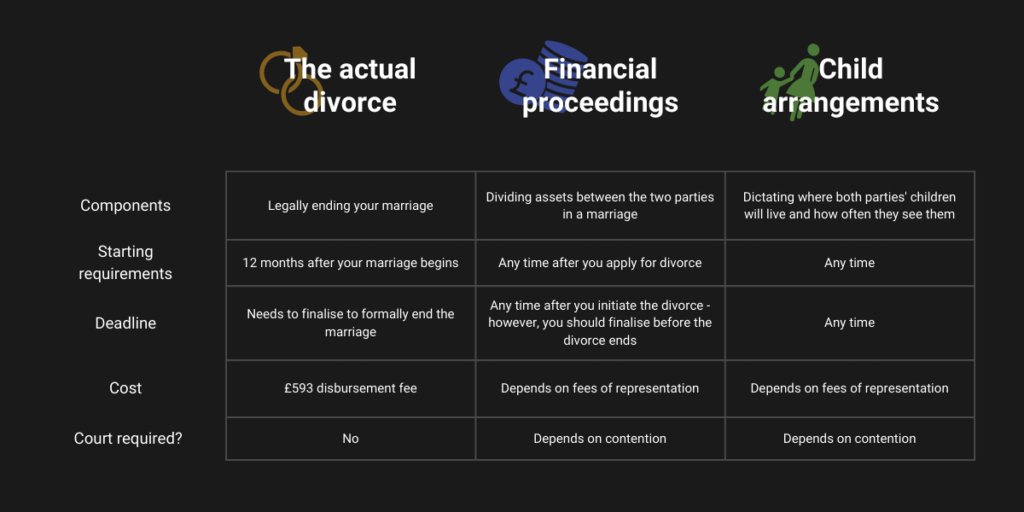
What are the three main areas of divorce?
The legal process of getting a divorce is split into three distinct areas:
- the legal ending of the marriage;
- divorce financial proceedings; and
- child arrangements.
Importantly, these three areas can occur simultaneously, meaning you’ll most likely be considering assets and children early on in the divorce. It’s important to consider these things early on so that you have an idea of who will be getting what and where your children will spend their time.
Getting a divorce: making an application
If you’ve decided that no other options will work and getting a divorce is truly what you want, then the next stage is submitting a divorce application.
Am I eligible for a divorce?
Before proceeding with the divorce, you’ll first have to check that you’re eligible. This means that your marriage must:
- be at least 12 months old;
- have permanently broken down; and
- be legally recognised in the UK.
Furthermore, the UK must be your permanent home, or your spouse’s.
Do I need a specific reason to file for divorce?
No – there is no requirement in England and Wales to provide a reason for getting a divorce.
In the past, you needed to provide grounds for divorce. You may have heard this in the past when people said they had ‘irreconcilable differences’, but a reason isn’t required anymore.
Now, you simply have to state that your marriage has broken down to be eligible.
Which divorce application will I need?
To start the process, either one or both spouses will need to submit an application to the court.
The process differs slightly on whether you’re applying solely or dually.
Sole applications
In a sole application, one spouse applies on their own. The party that applies for divorce is called the Applicant, whilst the other party becomes the Respondent.
The Applicant is responsible for the entire application, including applying for the Conditional Order and Final Order. They’ll also need to pay the £612 divorce application fee (correct as of April 2025).
After the Applicant files for divorce, the Respondent receives divorce papers alongside an Acknowledgement of Service (AOS). This allows the court to confirm that they are aware of the divorce application.
You cannot change a sole application to a joint application.
Joint applications
In a joint application, both spouses apply together. In the application, one person becomes Applicant 1, whilst the other becomes Applicant 2.
Whilst Applicant 1 is the main point of contact, both parties are responsible for the application. This means that they will apply for the application, conditional order and final order together.
Applicant 1 will need to pay the divorce application fee of £612.
You can change a joint application to a sole application later down the line if you wish.
What information will I need to provide?
To apply for divorce, alongside your relevant application, you’ll need to provide the following:
- you and your spouse’s full name and address; and
- your original marriage certificate.
If you don’t know your spouse’s address, or you don’t know their whereabouts, you’ll have to try other methods instead. For example, you can instruct a tracing agent to find them.
What happens after I submit the application?
Once you submit your application, you’ll then have to wait for the court to advise you can apply for a Conditional Order. This usually takes around 20 weeks.
Once you have the Conditional Order, you’ll need to wait a further 6 weeks and 1 day to apply for the final order. After the court issues this, your marriage is officially over.
Typically, the court will grant both orders with no issue. However, it may be wise to delay applying for the final order until you finalise the financial proceedings. This is because getting a divorce will complicate things financially.
Getting a divorce: the other areas.
As mentioned, the divorce application isn’t the only area that you’ll need to consider. If you share assets and have children with your partner, you’ll need to agree with your partner on how you’d like to split your assets and finances, and child arrangements.
The financial settlement
The financial settlement sets out how any assets you have, such as the family home, are split. It also divides any finances you have such as savings, investments and ISAs, pensions etc.
Perhaps unsurprisingly, it’s the financial settlement that typically causes the most disagreement when getting a divorce. It’s also the part of divorce that tends to increase legal bills due to the back and forth communication, and arguments over what should be considered a marital or non-marital asset.
Non-marital assets include things you or your spouse owned prior to getting married. Depending on what these assets are, how long you’ve owned them and your financial arrangements, non-marital assets can become or be considered marital assets. For example, your spouse could make a claim on a property you owned prior to the marriage if you let it out to renters and use the income to pay for a family holiday.
Usually when disagreements over finances arise, it’s over whether an asset is marital or non-marital, or a perceived unfair split. Many people use a solicitor to agree a divorce financial settlement as they simply don’t know what’s fair or not.
Child arrangements
Whilst not mandatory to complete before their marriage ends, many couples sort out their child arrangements alongside their divorce.
Your child arrangements will include things like:
- choosing where your children will live and who with;
- allocating time for each spouse to see their children;
- if you are religious, which religion your children follow;
- specifying times for calls and other forms of communication; and
- child maintenance plans.
If you have children, this may drastically affect the court’s decisions in handling finances too. They tend to favour the side that the children spend the majority of their time with.
Should I consider mediation?
With family mediation, you can potentially reach some middle-ground with your spouse regarding finances and children. A third-party mediator will help to accomplish this.
It’s never too late to try mediation and the courts will tend to favour the side that has tried to be more amicable.
Getting a divorce: what happens next?
Officially, your marriage is now over. Hopefully, you have finished the financial proceedings and are ready to start anew.
Although, there are a few other things you may need to consider for life after divorce. For example, you may need to rewrite your will or consider capital gains tax from any assets you acquire.
What if divorce isn’t for me?
If you find that getting a divorce might not be the answer, you should consider some alternatives. If you’re unhappy in your marriage, but you don’t want a divorce, there are a number of options available for you to try:
Marriage counselling
If you think you can still remedy the breakdown in your marriage, you should first look at counselling.
Informal separation
Instead of getting a divorce, couples can agree to live apart whilst not officially ending their marriage.
Annulment
If you think that your marriage was never legally valid, or has become invalid in some way, you can apply for annulment.
Judicial separation
Whilst judicial separation does not end a marriage in the same way as divorce, it does formally end the marriage.
The final verdict
In spite of all the recent changes making the process simpler, getting a divorce can still prove to be a stressful experience.
Whilst it may be overwhelming, our team of expert divorce solicitors can help. I’ve seen my fair share of complex divorces, meaning regardless of how niche or contentious your divorce may be, we can help.
Whether you’re considering your options, looking to apply, or need advice on finances or children, contact us today and we can guide you through your divorce.
To get started, have a look through our ‘Getting a Divorce’ series by visiting the blogs below.
About the Author
