

Getting a Divorce – Your Questions Answered.
Getting a divorce is a significant life event regardless of whether you are divorcing amicably, or you no longer get on with your soon-to-be ex-partner. Below, we have compiled some of the most commonly asked questions and scenarios that our divorce solicitors encounter to help you plan for the next chapter of your life. Please note, while we use the term ‘divorce’ on this page, the advice here is also valid when it comes to ending civil partnerships.
Divorce laws changed on 6 April 2022 and couples no longer need to provide a reason to start divorce proceedings. Couples are also now able to apply for divorce individually or jointly.
General Divorce Questions
Q: How do I start a divorce?
A: To start a divorce, you, or your divorce solicitor will need to complete and submit a divorce application through gov.uk. You can do this as a couple or as an individual.
You will need to pay a divorce application fee when submitting your application (currently £628 as of 1 October 2026). If a solicitor is managing your divorce on your behalf, you will also need to pay their professional fees.
To submit your divorce application, you will need to provide:
- You and your partner’s full names and addresses*
- Your original marriage certificate or a certified copy of the marriage certificate**
- Proof of any name changes you have had since marriage, either through providing your marriage certificate, or a deed poll
*If you do not have your partner’s current address, you can note down their last known address.
**For overseas marriage certificates in another language, you will also need to provide a certified translation of the certificate.
In addition to these documents, you must also have been married for over 1 year.
The courts may reject your divorce application if any of the details submitted are incorrect.
If your partner has raised a divorce application and sends it to you, you don’t need to pay any application fees, even if they ask you to.
Q: How much does a divorce cost?
A: This will depend on a variety of factors. If you have a simple divorce with no child arrangements or divorce financial settlement, you’ll only need to pay £628 to issue the divorce application.
However, if you need to apply for child arrangements and/or a divorce financial settlement and you disagree over these arrangements, other mandatory costs include:
| Item | What is it for? | Cost |
|---|---|---|
| Mediation | If you disagree with your partner over child arrangements or how to split your finances, you must show you have tried to go through mediation. | Usually between £100 to £150 per person |
| Child arrangements | The cost of applying to the courts to agree child arrangements if you and your partner disagree. | £270 |
| Non-contested financial order | The cost of applying to the court to formalise a financial division between you and your partner when you both agree. | £62 |
| Contested financial order | The cost of applying to the court for a financial order when you and your partner cannot come to an agreement over finances and require the court’s intervention. | £321 |
None of the costs above include a solicitor’s professional fees if you choose to instruct a firm.
While it is possible to make informal child and financial arrangements informally with your partner at no cost, we strongly advise against this. While informal agreements can work, they aren’t legally enforceable.
This is especially important when it comes to financial settlements as you are effectively relying on your partner to keep their word and vice versa. While you may agree on things now, you or your partner’s circumstances may change leading to disagreements further down the line.
Q: Does my partner have to agree to the divorce?
A: No. Since ‘no fault divorces’ were introduced on 6 April 2022, your divorce can proceed whether or not your partner agrees in the vast majority of cases.
The main exception to this is if your partner disagrees with the divorce on grounds of jurisdiction, i.e. that the divorce should be taking place in another country.
This mainly applies where one of you lives, or spends a lot of time living in another country, or as a couple you have spent significant time living abroad.
Q: How long does divorce take?
A: In extremely simple cases that don’t involve any children or assets, getting a divorce can theoretically take as little as 4 months.
However, in reality, things will take longer. If your divorce involves finances and children and you can’t resolve things informally, it could take up to 12 months or longer.
This will depend on whether the courts have availability to hear your matter. Usually though, divorce takes around 6 – 10 months for most couples.
There is a minimum of 20 weeks between applying for a divorce and receiving your conditional order, and a minimum of 6 weeks between the courts issuing the conditional order and the final order.
Q: Do I need a solicitor to manage my divorce?
A: Not always, but it’s advisable to get one if you have children and property. How complex a divorce becomes depends on 3 main factors:
- First, your relationship with your soon to be ex-partner. If you’re not on good terms, there’ll likely be disagreements over who gets what.
- Second, whether you have children and/or property between you.
- Third, how difficult your partner is. This can indicate how easy or difficult it will be to reach a compromise.
Don’t underestimate the third factor as, for many people, the real cost of divorce comes from disagreements over finances. Using solicitors can help to separate emotion from the divorce process and get you better – and quicker – results.
We advise clients to seek legal advice if you or your partner:
- Have children and anticipate disagreeing over who they spend time with
- Own a property jointly, or either of you own a property individually or with anyone else, including your marital home
- Have recently received a significant inheritance
- Earn significantly more or less than the other
- Own shares in, or are directors of, a business
- Receive dividend income from a business
- Have a significant pension pot
- Have complex assets, or you believe your partner may have particularly opaque financial affairs
While discussing finances can be difficult, we strongly urge all clients to seek legal advice on financial settlements. This is particularly important if you are inclined to agree to let your partner ‘have everything’ or dictate the terms of your financial settlement, as it can be exceptionally difficult to vary a financial order once it is granted.
You don’t have to use a solicitor, but you’ll need to understand what you’re doing. That means drafting all of the paperwork correctly and completing the applications for both child arrangements and financial orders yourself.
Q: Are there any alternatives to divorce?
A: Yes. Judicial separation offers couples a way to divide their assets and children without having to go through a formal divorce.
A formal application still needs to be made and it costs £426. Some couples choose judicial separation rather than getting a divorce for religious or cultural reasons, or because they don’t yet meet the 1-year marriage requirement for divorce.
As with divorce, during judicial separation couples can apply for child arrangements and a financial order. However, crucially, judicial separation does not mean you are divorced, and if you choose to end your marriage later, you will need to get a divorce.
Q: How do we decide who gets what and who the children live with?
A: Getting a divorce consists of 2 to 3 separate applications, depending on whether you have children:
- The divorce application, which legally ends your marriage
- The financial remedy consent order, which divides your assets and financial affairs
- A child arrangements order, which manages affairs regarding your children
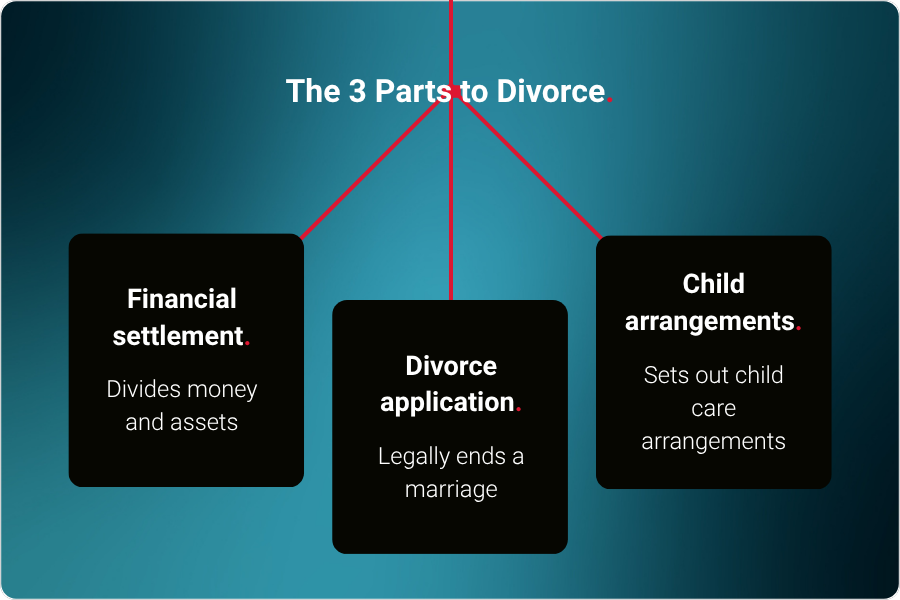
Each application is separate, with separate fees payable and submitting a divorce application does not automatically finalise your child and financial arrangements.
Q: My spouse is the main earner or I have limited funds to finance the divorce. What can I do?
A: There are various options that may help you fund the cost of a divorce. These include:
- Asking whether your solicitor can provide fixed fees on divorce services, or has payment plans available
- Requesting a deferred payment arrangement from your solicitor, such as a Sears Tooth agreement, which secures legal fees against your future divorce financial settlement
- Obtaining a divorce litigation loan, which, again can be secured against your anticipated divorce financial settlement
- Applying for a Legal Services Payment Order if your partner earns significantly more than you
- Requesting personal loans from friends or family members
- Applying for Legal Aid, although the eligibility criteria are very strict
If your partner earns significantly more than you and you are unable to afford day-to-day costs, you can also apply for Maintenance Pending Suit, which helps you pay your daily expenses. However, you cannot use maintenance pending suit to pay legal fees.
Children and Divorce
Q: How do we decide who our children live with?
A: You can choose to formally or informally agree on child arrangements with your ex-partner before, during or after getting a divorce.
Most commonly, child arrangements include things like:
- Who your child lives with and whether care is split
- How long they spend living at each parent’s house
- Whether one parent can move away and take any children with them
- Where they spend their time during special occasions
- How major life decisions, such as what school a child goes to, should be made
- How both parents should communicate with each other regarding children
- Whether any contact needs to be supervised
Unless a formal child arrangements order is granted, any arrangements you make with your partner are not legally binding. This means your partner doesn’t have to abide by the agreement at any time, or vice versa and there are no legal consequences.
If you have obtained a binding child arrangement order, you can simply ask the court to enforce the terms. If your partner refuses to comply or breaches the order, they could face financial penalties, community service or, in the most severe cases, imprisonment.
When applying for a child arrangements order, you’ll need to go through mediation and have a Mediation Information and Assessment Meeting (MIAM). This usually costs around £90 to £130 per parent.
An organisation called CAFCASS will also be involved. CAFCASS’ role is to ensure the welfare of the children, and they will carry out standard safeguarding checks with the children and parents, regardless of whether any concerns are raised. If either parent raises concerns about the other, or, during its initial checks, CAFCASS identifies any safeguarding issues, it may investigate further.
When making child arrangements or applying for a child arrangements order, it’s important to remember that the court primarily looks at one thing: what is best for the children.
Q: What if we agree on who our children live with, but not on other things?
A: Child arrangements orders normally cover the day-to-day of you and your children’s lives. If there are certain decisions in your child’s life that you cannot agree on with your partner, you may need to apply for a Specific Issue Order, or a Prohibited Steps Order.
You can apply for these orders with your initial child arrangements order application, or later down the line.
Specific Issue Orders force an agreement on certain decisions, such as:
- Which school a child should go to, whether they change schools, and the type of education they receive
- Whether a child receives certain vaccinations or undergoes certain medical treatments
- What religion a child should follow and which religious practices they participate in
- Whether a child is allowed to move to a new area, or to a different country
- Whether a child is permitted to travel abroad and when
- If a child’s name or surname can be changed
- How a child’s passport renewal should be handled, if consent could be an issue
Similarly, Prohibited Steps Orders forbid certain decisions from taking place.
Both Specific Issue Orders and Prohibited Steps Orders can be used in tandem. For example, a couple may have a Prohibited Steps Order which forbids either parent from removing their child from their current primary school. A Specific Issue Order may then be required to determine which secondary school the child should attend, if the parents disagree.
Both types of order aren’t permanent, although they may take effect for years at a time. They can also be varied if circumstances change.
Q: Can one parent decide they don’t want anything to do with their child?
A: Yes and no. This is a complicated issue.
When a child is born, usually both parents are granted parental responsibility. This means both parents are responsible for a child’s welfare and for providing for the child financially.
If the couple splits up and one parent moves away, both parents continue to have parental responsibility. The parent who left retains the duty to look after the child, including providing for them financially. If they fail to do so, the court may order them to pay child maintenance.
While it is unusual for a parent to try to sever their parental responsibility and for the courts to grant this, it can happen. This will usually be if the court determines continued contact with the parent is not in a child’s best interests, but this is exceptionally rare.
However. parental responsibility and the duty to pay child maintenance can be removed automatically by other means.
Adoption Orders sever parental responsibility from one, or both, of a child’s biological parents and establish new parental responsibilities with the adoptive parent or parents. This is helpful for adoptive parents and step-parents.
Equally, Parental Orders establish parental responsibility for adults following surrogacy. In this situation, parental responsibility is removed from the surrogate mother, and granted to one or both of the prospective parents.
Q: Will the courts automatically rule that our child should live with their mother?
A: No, but this is a common concern for fathers.
The family court places great emphasis on the child’s welfare and on which parent is the primary caregiver. Normally, children spend some time with each parent, but who a child spends more time with depends on who the primary caregiver is and what makes sense for the child, rather than the parent’s gender.
Statistically, joint custody is still slightly skewed in favour of women, but this is due to socioeconomic factors rather than any bias of the courts. This is because women are still, on average, more likely than men to be the primary caregiver and to have been earning less than the father.
These days, every case is treated separately. If it makes more sense for a child to spend more time with their father, the courts will take that into consideration.
Q: How do we agree child maintenance?
A: The family court encourages couples to come to an informal arrangement between themselves for child maintenance. However, it also recognises this isn’t always possible.
If an informal arrangement is impossible, you can make an application to the Child Maintenance Service (CMS) at a cost of £20. If you are legally married, you can do this before, during or after getting a divorce.
Payments through the CMS are legally binding and the CMS has the power to enforce payments.
The CMS isn’t suitable for every situation. Some exceptional family circumstances can benefit from making an application for a court order. These situations may include when:
- Your partner’s income is significantly higher than yours and the CMS wouldn’t award what you consider fair
- You have additional outgoings for things like education or your child has a disability that the CMS doesn’t take into account
- Your ex-partner lives outside the UK and therefore the jurisdiction of the CMS
You’ll normally need to contact the Child Maintenance Service yourself to seek their help.
Q: How much should child maintenance be?
A: The Child Maintenance Service (CMS) provides guidance for basic levels of child maintenance and a child maintenance calculator to help tally the sums.
These calculations can show you how much should be paid under informal child arrangements. It will also form the basis of any orders the CMS makes. The calculated amount takes into account:
- The payer’s income
- The number of children there are
- Child living arrangements
- Whether or not there are any children from other marriages
- Contributions to miscellaneous costs such as school uniforms and activities
Q: Can I change our child arrangements after they have been agreed?
A: Yes. You can ask the family courts to vary an approved order if you or your partner’s circumstances change.
If the change is in the best interests of your child’s welfare, the court is unlikely to block it. However, bear in mind that child arrangement orders are no longer effective once a child turns 16, or 18 under specific circumstances.
It may also be better to apply for a Specific Issue Order or a Prohibited Steps Order depending on the nature of the change in circumstances.
Finances and Divorce
Q: How much am I entitled to?
A: The starting point for all divorce financial settlements is a 50/50 split of your matrimonial assets when getting a divorce.
This can and does change, and you will often hear and see the term ‘needs‘ when discussing divorce financial settlements.
It’s these needs that determine whether one side should receive more or less of the overall matrimonial assets, however some needs are more significant than others.
Most commonly, these needs include:
| Need | Effect | Weighting |
|---|---|---|
| Children’s housing needs | The parent providing the majority of children’s care may receive a larger share of assets so they can suitably accommodate the children. | Heavy |
| Earnings disparities | A partner earning significantly less may be entitled to more in the settlement, particularly if they gave up work to look after any children. | Heavy |
| General financial needs | Both sides need to be able to afford suitable housing and living expenses following any financial settlement. | Heavy |
| Length of marriage | Short marriages may lead to an uneven split, particularly if one partner had significantly more assets upon getting married. | Medium |
| Pre-marital assets | Assets earned or gained prior to marriage could be excluded from equal sharing, but this isn’t always the case. | Medium |
| Inheritance and gifts | Any inheritance or gifts can sometimes be treated differently to marital assets accumulated together. | Medium |
| Disabilities | Disabilities or long-term severe medical conditions can mean one party receives more than the other. | Medium |
| Pensions | Pension pot sizes and future earning potential can affect the size of any divorce settlement. | Medium |
| Financial misconduct | A partner deliberately hiding or obscuring financial assets can lead the courts to award more to the other partner. | Medium |
You don’t have to abide by a 50/50 split and you can agree any financial settlement with your partner informally, but if you change your mind later down the line, it can be extremely difficult to change.
During the process of applying for a divorce financial settlement, you will go through a disclosure stage where you and your partner will each need to set out the assets and liabilities that you have.
This is then compared and forms the basis from which the divorce financial settlement is made.
Usually, people seek help from a solicitor during financial settlements because they do not know what they are reasonably entitled to, they don’t believe their partner is being honest about their financial situation, or they simply cannot agree a settlement.
In these situations, it’s best to seek legal advice.
Q: How do we decide who gets the house and what about the mortgage?
A: This depends on each person’s needs. The court takes into account a number of factors including the needs of any children, who the primary carer is and the incomes of each partner. Normally, the primary carer will keep the house if they can afford to run it, and it’s big enough for them and the children. However, this doesn’t mean the property won’t be sold.
Mesher Orders can stipulate conditions of sale, for example when the youngest child reaches 18 or finishes university. You’ll both maintain any equity you hold in the property, as well as any mortgage responsibilities until it’s sold.
The non-primary carer is expected to rent or buy another property if they have the means to do so. However, if they do not, it’s likely the court will order the sale of the marital home to ensure both sides are suitably accommodated.
Similarly, if the family home is larger than required by the primary carer and the children, the courts may order its sale. This frees up equity for both partners while allowing the primary carer to secure alternative suitable accommodation.
Q: What happens to our pensions?
A: Normally, pensions are split in one of two ways:
By pension sharing order. This is where one partner moves part of their pension into a new and separate pot for the other partner.
Or by pension offsetting. This involves an immediate cash payment to effectively offset any hypothetical future pension allocations or accruals.
Pension offsetting can only be an option where there are marital assets that can be used to offset any split of the pension pots.
Many couples who agree divorce financial settlements informally forget about pensions, particularly if they are getting divorced before retirement age. Many others simply don’t know that pensions can be shared.
Q: Can my ex-partner take part of a future inheritance?
A: Maybe. It’s possible for a divorce financial settlement to take into account future inheritances under certain circumstances. This is normally when the inheritance is imminent and the inheritance is significant.
Any inheritance received during the marriage will likely constitute a marital asset and be split accordingly.
Q: Am I expected to share personal belongings with my ex?
A: Maybe. Most couples will agree a split of assets and belongings during divorce based upon each person’s individual needs and, to a certain degree, their attachment to any belongings. Smaller assets like furniture are typically easier to divide than things like cars, expensive appliances or antiques.
Scenarios can arise where financial settlements are drawn out due to tit-for-tat disputes over sentimental items that hold little financial value. Under these circumstances, as with any negotiation, it may be better to give up some of these items for the sake of drawing the process to a close.
If the court needs to intervene to share personal belongings, they will normally ask for a Scott Schedule to be completed. A Scott Schedule sets out all the marital assets and their values. The judge will then split these according to each side’s needs.
Q: Is my partner entitled to things that I owned before we married?
A: Maybe. Solicitors and divorce advice services talk a lot about ‘mingling‘ of assets when it comes to divorce. Your assets fall under two categories during the process: matrimonial and non-matrimonial. Matrimonial, or marital assets are those gained during marriage.
And non-matrimonial assets include assets gained before or after you married, or assets held by neither partner, for example in a company or a trust. Divorce financial settlements take into account everything acquired during marriage, but can include non-matrimonial assets too.
The difficult part is that non-matrimonial assets can become or be considered matrimonial assets either in part or in full, depending on a wide range of circumstances. Some assets can also occupy a grey area where they could be considered matrimonial or non-matrimonial:
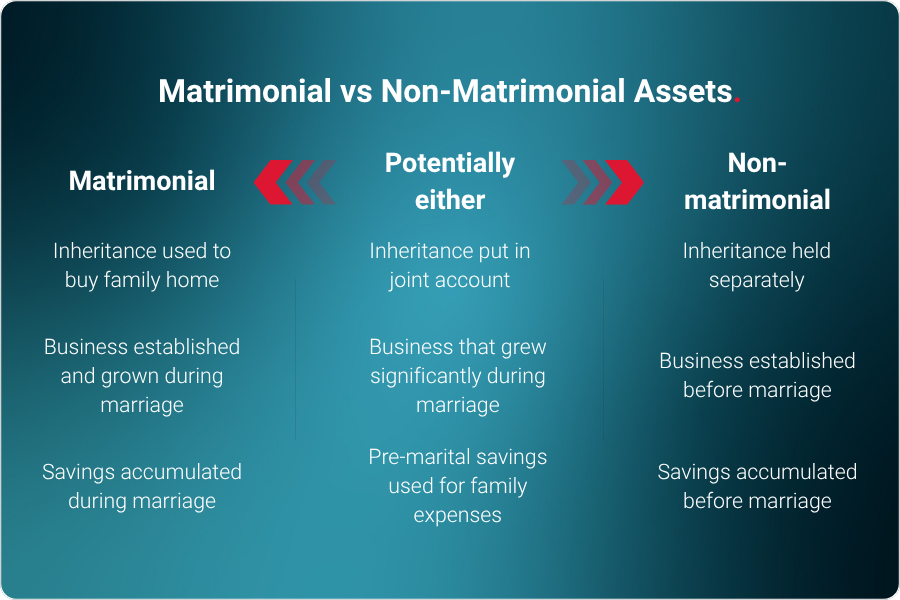
You can request that a judge excludes any non-matrimonial assets from your financial settlement, but they will consider two things:
- Whether the non-matrimonial assets ‘mingled’ in any way with marital assets. By mingling, the non-matrimonial asset, or part of it, might become a marital asset. For example, using part of an inheritance to put down a deposit on a family home could draw the inheritance into question as a marital asset.
- If after splitting the marital assets, one party’s needs are still unmet, non-matrimonial assets may be considered.
Q: After we come to an agreement, can my ex claim any further finances or assets?
A: Maybe. If you want to ensure that your ex can’t make a claim on future assets or finances after your marriage has ended, you must ensure that you get a ‘clean break order‘. A clean break means that both you and your partner agree that any financial settlement is final. It also means that neither side can pursue the other for finances after the divorce. It effectively severs your financial connections.
If you don’t get a clean break order, your ex-partner could potentially file a claim years down the line. One often quoted example is that of Nigel Page who won £56 million in the Lottery in 2010. He divorced his wife 10 years prior to his good fortune, but his wife was still able to file a claim and ultimately walk away with £2 million.
Similarly, if you agree a financial settlement informally and it heavily favours one side, the other person could argue later down the line that they did not understand the terms of the settlement, and re-open the issue.
About the Author
