
On 19 November 2026, the government unveiled a new Commonhold and Leasehold Reform Bill. While the bill isn’t law yet, it builds off the Leasehold and Freehold Reform Act 2024, and, if it passes, proposes capping ground rent for many existing leaseholders and making commonhold the usual form of ownership for most new flats in England and Wales.
For existing leaseholders, the announcement hasn’t changed your lease or reduced your next ground rent bill – yet. But if you’re buying, selling, thinking about extending a lease, or you’re a freeholder, you may have immediate questions or concerns about what the future holds.
What will the Commonhold and Leasehold Reform Bill change?
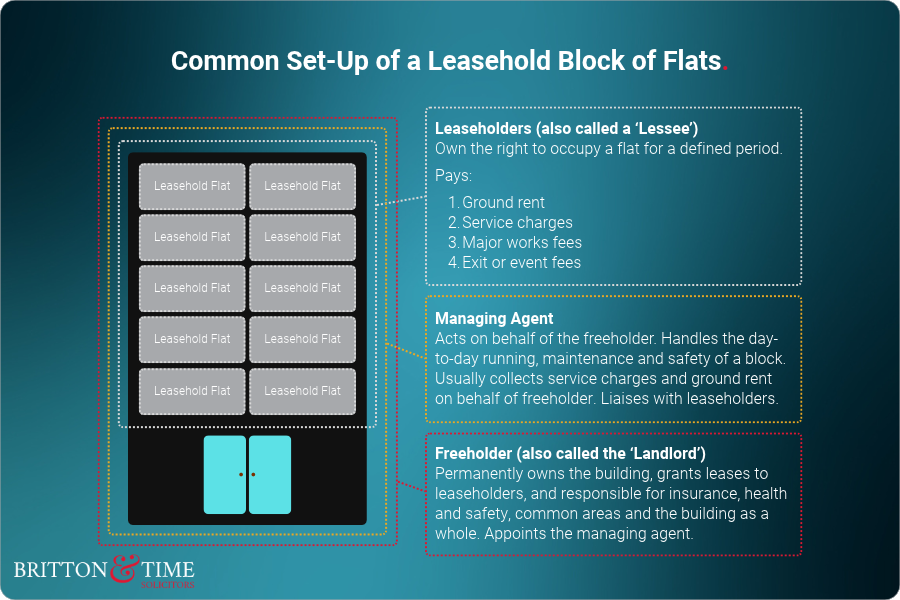
Under the leasehold system, leaseholders own the right to occupy their flat for the term of their lease, with the freeholder owning the building, also called the ‘freehold’. Despite this system having been in place in the UK for the last 1,000 years, leaseholding, as a type of ownership, is deeply unpopular with many buyers.
The Commonhold and Leasehold Reform Bill is the government’s first step towards phasing out the current leasehold system and modernising it with regulations designed to provide current leaseholders and future commonholders with more security over their homes and costs.
Commonholding isn’t new and has been around since 2004, however leaseholding has remained the dominant form of home ownership.
The most highly publicised parts of the new bill set out to do 5 things:
- Force new blocks of flats to adopt the commonhold model by banning new leaseholds
- Make it easier for leaseholders in blocks of flats to convert to the commonhold model
- Cap ground rents at £250 and reduce them to a peppercorn rent after 40 years
- Replace forfeiture (the ability for landlords to take back leasehold properties under certain circumstances) with a fairer system
- Change how freeholders can use existing estate rentcharge laws to recover unpaid arrears
These proposed changes are currently being discussed, but the government hopes to bring it into use before the end of 2029.
Why is leaseholding so unpopular?
Leaseholders are deeply unpopular among homeowners for a wide array of reasons, including mandatory annual costs and a depreciating property value tied to the number of years left on their lease.
The most common reasons for leaseholding being an unpopular form of home ownership are:
Renewing the lease and declining property value over time
Leases are normally granted for a period of 99, 125 or 999 years and when you purchase a leasehold property, the lease is transferred to you, together with its remaining duration.
However just because a lease has a large number of years remaining doesn’t mean you don’t need to renew it and leaseholders will look to renew their lease before the number of years remaining drops below 80.
This is because in England and Wales, if a lease has fewer than 80 years remaining on it, the freeholder is entitled to charge what’s called a ‘marriage value’ in addition to a normal lease extension premium, and this marriage value hugely increases the cost of extending a lease to the tune of potentially tens of thousands of pounds.
Furthermore, once this marriage value comes into effect, it’s likely to negatively affect the sale value a property can achieve and how much a bank is willing to lend against it.
Ongoing service charges
Leaseholders must pay service charges which are generally used to maintain the structure and common areas or facilities. While most leaseholders accept a service charge must be paid, however issues can arise when maintenance isn’t being conducted, there is poor service from the managing agent, or if additional maintenance costs are required.
Rising ground rents
Many leaseholders pay ground rent to the freeholder in exchange for the right to occupy their land. However, many leases also contain provisions whereby the freeholder is entitled to increase ground rents, sometimes expotentially.
In recent years, year-on-year increases in ground rents have made headlines, with some homeowners unable to afford increases, while also being unable to sell their property for the same reason.
While scenarios like this are relatively uncommon, many leaseholders are unhappy with having to pay a fee for which they see no return and which could be increased without their consent.
Consent and alteration charges
Some leases come with certain restrictions whereby a leaseholder must seek consent from the freeholder prior to taking action. The restricted items can be routine things such as maintenance or decorating, but if they are outlined in the lease, the freeholder may be entitled to charge reasonable consent fees for considering your request.
These items can include things like changing or upgrading your boiler, changing your flooring, requesting permission to keep a pet or subletting the property. Some landlords charge up to £1,000 per request, which may be payable by the leaseholder.
Many leaseholders are understandably unhappy at having to pay costs for making reasonable, and sometimes unavoidable requests, particularly when they have already paid a significant sum to purchase their property.
Due to the above, many buyers try to avoid leasehold properties due to the ‘strings’ that come attached and the lack of control over future costs.
While the Commonhold and Leasehold Reform Bill may change some of these issues, it won’t completely remove them.
What will commonhold ownership look like?
Commonhold ownership exists currently, but the Commonhold and Leasehold Reform Bill promises to reform how it looks and operates.
Currently, many leasehold blocks of flats operate like the below where the building is owned by a freeholder, managed by a managing agent, with leases granted to leaseholders:
Once the bill takes effect, for new blocks of flats and those that choose to convert to commonholds, the structure will look slightly different, with a commonhold association now collectively owning the building and commonholders owning their flats permanently.
Managing agents will likely continue to play a role in managing the day-to-day of commonhold buildings, however flat owners will now have a much larger influence in how the agents themselves are managed.
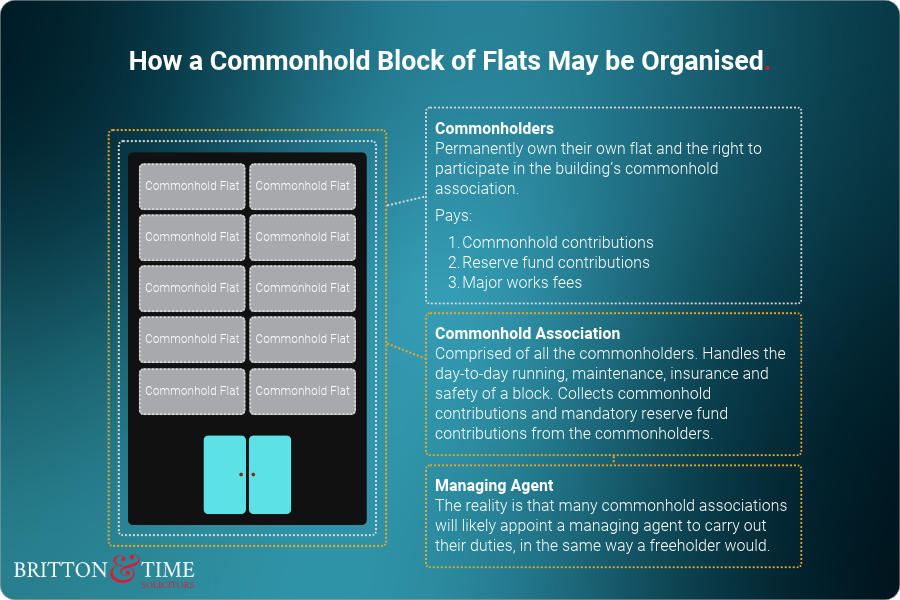
Leases won’t disappear entirely and instead commonholders will own a permanent lease. Leases will still govern what can and cannot be done by property owners, however as those property owners will form part of the commonhold association, in practice any restrictions contained within a lease may be more flexible.
For anyone thinking that this sounds similar to owning a flat with a share of freehold, there are 3 key differences:
- Commonholders have a lease that does not expire. Flats with a share of freehold have a lease that will still need to be renewed, albeit at a lower cost than if the property were leasehold.
- Commonholders will have more consistent management rights through a commonhold association than existing managing arrangements by owners of share-of-freehold properties.
- Commonholders will need to make mandatory contributions to a reserve fund, while those in a share-of-freehold do not.
Interestingly, the bill will also provide the option for existing share-of-freehold buildings to convert to commonhold.
Should leaseholders delay extending their lease?
There isn’t a definite yes or no answer to this question, rather there are several points we would recommend you to consider:
- The bill has not yet passed into law and elements of it may still change.
- If you have fewer than 80 years remaining on your lease, you may benefit financially from waiting for marriage values to be abolished.
- The government has legislated to increase minimum lease renewals to add 990 years from 1 November 2028.
- If you need to sell your property imminently or re-mortgage, you may benefit from an extended lease.
- If you may want to sell your property in the next 5 years, how commonholds may affect future property prices.
- There is no guarantee even after the bill comes into effect that other leaseholders will want to convert to commonhold.
The final point is important as although the Commonhold and Leasehold Reform Bill promises big changes, leaseholders in particular won’t automatically be affected by every change.
How will these changes impact freeholders?
The government’s own impact assessment states they expect freehold values to decline, particularly for freeholders who derive a significant proportion of revenue from ground rents.
Together with the abolition of marriage values and revised valuation rules during enfranchisement, these three changes will likely have a major impact upon freeholders.
Again, it’s important to emphasise that the bill isn’t going to abolish the current rights of freeholders overnight, however the government’s intention is clear in that they want to disincentivise the commercialisation and profiting from owning freeholds.
Indeed, occupants of a well-run leasehold building may have little incentive to convert to commonhold ownership once they have added 990 years to their lease with stricter valuation controls in place.
It’s also important to state that just because many leaseholders may want to go through enfranchisement and purchase the freehold of a building, it doesn’t mean that they will. Enfranchisement is widely desired in principle and has been a possibility since 1993, but few leaseholders are motivated to follow through, at least with current rules.
Other major changes in the bill
As with most legislative changes, the Commonhold and Leasehold Reform Bill, together with its predecessor the Leasehold and Freehold Reform Act 2024 contain a lot of changes and many haven’t been widely discussed or reported on.
We have compiled a useful list of many of the current rules and how they are changing below:
| Changes to | Current rules | Proposed rules |
|---|---|---|
| Ground rents | Can rise as per a lease with no cap in place. | Can still rise but capped at £250 per year and can be reduced to a peppercorn rent after 40 years. |
| Service charge increases | Can rise sharply in line with ongoing maintenance and insurance costs. | No change. |
| Consent charges | The freeholder’s reasonable costs may be payable by the leaseholder upon each request. | New bill gives powers to reduce these costs to £0 but not yet decided. |
| Unexpected costs | Major works require consultation with leaseholders for contributions over £250. Costs for works not covered by service charges and where a reserve fund doesn’t exist are borne by leaseholders. | Consultation threshold will increase to £500 and reserve funds will become mandatory, including for existing leasehold buildings. |
| Insurance costs | No requirement for insurance costs to be explained to leaseholders. | Separate reforms are being implemented to increase insurance transparency. |
| Lease extensions | Leases lose years over time and must be extended at a cost, adding an average of 90 years to the lease. Requirement to wait 2 years prior to extending a lease was removed in January 2025. | Existing leases will remain in place with new rules on costs and qualifying statutory extensions will add 990 years, generally with a peppercorn rent. Leases can be converted into commonholds which do not expire. |
| Lease extension legal costs | Often paid by leaseholder. | General rule will be that each party pays their own process costs, subject to exceptions. |
| Marriage values | Comes into effect when a lease has 80 years or fewer remaining. | Abolished for statutory lease extensions and freehold acquisitions. |
| New properties | New and existing leasehold properties can still be sold. | No new leasehold properties can be sold and are replaced by commonholds. Existing leaseholds can still be sold. |
| Building management | Leaseholders have limited control over building and managing agent. | Leaseholders will continue to have limited control unless they convert to commonholds. Commonholders participate in a commonhold association with voting and governance rights over the building. |
| Converting to commonhold | Requires almost unanimous leaseholder and lender consent. | Requires 50% of qualifying leaseholders to consent and freehold must be acquired. Non-participants remain leaseholders. |
| Enfranchisement | Restrictions around mixed-use premises, marriage values, ground rents, the freeholder’s costs and consent requirements complicate the process. | Reforms to almost all of these areas will make enfranchisement simpler and cheaper. |
| Forfeiture | Leaseholders can face forfeiture and lose the equity in their home in extreme cases. | Abolished but replaced by a statutory court-led enforcement process. |
| Shared ownership | Leaseholders may not be able to extend their lease where the housing provider doesn’t hold a sufficiently long superior lease. | The government has said it will correct this issue, but hasn’t released details of how yet. |
This isn’t an exhaustive list and when we reviewed the legislation, we counted around 51 changes that will affect leaseholders, with many new laws coming into effect around commonholds.
Are any parts of the bill already live?
When taken in combination with the Leasehold and Freehold Reform Act 2024, yes. Since 31 January 2025, the requirement for leaseholders to have owned a lease for 2 years prior to requesting a statutory lease extension has been abolished, however eligibility rules still apply.
As of 3 March 2025, Right to Manage reforms now allow more leaseholders in mixed use buildings to apply for the Right to Manage. Previous rules stated that only leaseholders in a building where commercial premises occupied up to 25% of available floorspace could apply. This has now increased to 50%. Leaseholders also no longer need to pay the freeholder’s legal fees when putting in a Right to Manage claim.
Some legal mechanisms have also been amended to enable future outlined changes, such as the adding of 990 years to an existing lease, even if the headline change has yet to take effect.
How Britton and Time can help
Our residential property team can advise on lease extensions, freehold purchases and service charges disputes. If you are buying or selling a flat, our conveyancing solicitors can explain how its lease terms, any upcoming works and your lender’s requirements could affect the transaction. You can also subscribe to our newsletter below to keep ahead of any upcoming changes to the law.
If you would like to understand how the changes will impact upon your particular circumstances, please call us on 0203 007 5500, or email [email protected].
We’re here to help.


About the Author